On this page
As of 25 November 2026, China’s MFA consular FAQ still lists 31 December 2026 as the end date for the 48-country unilateral visa-free policy, with no official extension into 2027 published yet. The 30-day entry exemption for 48 of the listed countries remains in effect until 31 December 2026, 24:00. If you hold one of those passports and plan to fly in early 2027, do not buy non-refundable round-trip tickets on the assumption of an automatic renewal—either keep bookings refundable while watching official notices, apply for an L tourist visa, or structure a qualifying 240-hour transit route instead.
Official policy list: MFA Consular FAQ · MFA bilateral mutual-agreement list · Full 50-country table and downloadable CSV · Entry & transit checker. Last checked 2026-11-25.

Is China visa-free in 2027 for your passport?
Only Russia and Brunei have confirmed 2027 unilateral 30-day access right now; the 48-country group on the unilateral list is still scheduled to end on 31 December 2026, and the United States is not on the unilateral list at all.
The MFA consular FAQ lists 50 countries whose valid ordinary-passport holders may enter China under the 30-day entry exemption. Those listed nationalities sit in three different expiry groups:
| Passport group | Current published status (checked 2026-11-25) | What to do for a 2027 trip |
|---|---|---|
| 48-country group (UK, Canada, Australia, New Zealand, France, Germany, Italy, Spain, Netherlands, Switzerland, Ireland, Sweden, Japan, South Korea, Brazil, Argentina, Gulf states and others) | Ends 31 December 2026, 24:00 Beijing time; no 2027 extension published yet | Watch MFA notices; for Jan–Feb 2027, line up an L visa or a 240-hour transit route |
| Russia | Extended through 31 December 2027 | Covered for qualifying 30-day visits throughout 2027 |
| Brunei | No end date set | Covered for qualifying 30-day visits with no listed expiry |
| United States and other unlisted passports | Not on the unilateral 30-day list | Check the MFA bilateral mutual-agreement list first; otherwise plan a tourist (L) visa or a third-country 240-hour transit route |
Passports covered by China’s separate bilateral agreements—such as Singapore, Malaysia, Thailand, the UAE and Qatar—appear on the MFA bilateral mutual-agreement list rather than the unilateral 50-country table above, and are not governed by the 31 December 2026 unilateral deadline. You can also run your passport, stay length and route through our China entry and transit checker.
A few notable recent dates explain why many travelers assume 2027 is already settled when it is not:
- China began applying the entry exemption to Swedish ordinary-passport holders on 10 November 2025, through 31 December 2026.
- China began applying the entry exemption to ordinary-passport holders from Canada and the United Kingdom on 17 February 2026, through 31 December 2026.
- China has extended the entry exemption for Russian ordinary-passport holders until 31 December 2027.
- The MFA consular FAQ specifies no end date for Brunei under the entry exemption.
To check your exact nationality, notice date and official link in one place, use PandaWander’s China 30-day entry exemption country table and CSV.
US passport and a round trip to mainland China? Start with the tourist-visa route, unless you already hold a usable Chinese visa or qualify for a specific exemption. The United States is not on the NIA's published unilateral exemption list. See China entry planning for US passport holders for the consular-jurisdiction workflow.
Should you wait for a 2027 extension or apply for a tourist visa now?
Base the decision on your departure month, not on rumors. China previously announced the 2026 extension on 3 November 2025, just under two months before the prior cutoff—which is why many travelers still expect a late-year announcement, yet no notice is guaranteed until the Ministry of Foreign Affairs publishes one.
| When you plan to travel | Practical move right now |
|---|---|
| Entering and leaving before 31 Dec 2026 | Covered under the current 48-country waiver if your passport and trip purpose match the rules below. |
| Landing in late Dec 2026 and departing in Jan 2027 | Official notices state 31 December 2026, 24:00 as the policy cutoff without publishing a separate cross-year stay exception. Confirm with your airline and the Chinese embassy or consulate serving your area before boarding, or obtain an L visa if your January departure cannot move. |
| Arriving in Jan–Feb 2027 (including Lunar New Year) | Too close to wait passively on non-refundable plans. Check your local consulate or visa application center’s appointment and processing timeline now, or switch to a qualifying 240-hour transit route. |
| Arriving in Spring 2027 or later | Book refundable hotels and flexible airfares first. Set a calendar cutoff ahead of your consulate’s processing window to submit an L-visa application if no official extension is posted by then. |
The Chinese consulate's application guidance identifies the L visa as the category for tourism. If you already hold an older multi-year Chinese visa, check its Entries, Enter Before, and Duration of Each Stay fields before starting a fresh application—China entry: tourist visa, exemptions or transit walks through each field.
Can you use 240-hour visa-free transit instead in 2027?
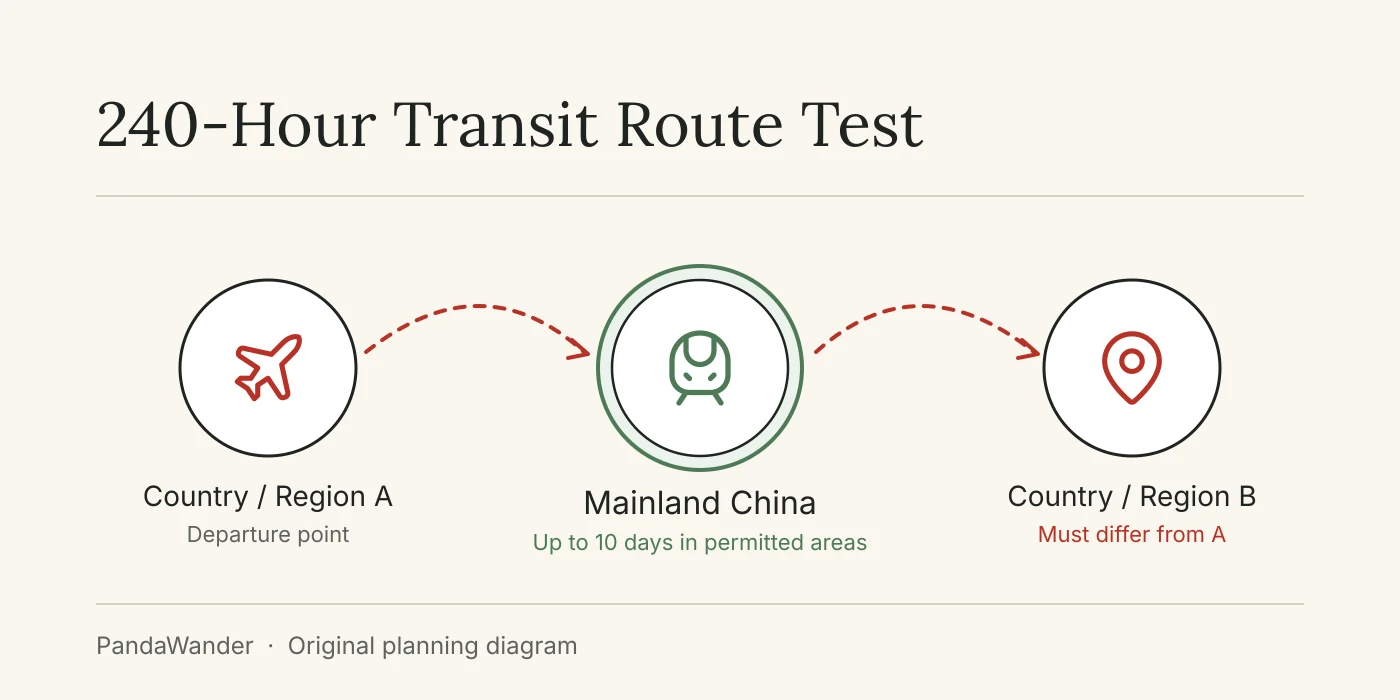
Yes—if your trip is 10 days or shorter and you route through mainland China on the way to a different country or region, the 240-hour transit policy is the cleanest 2027 backup. Unlike the 48-country 30-day waiver, the 240-hour transit scheme has no 31 December 2026 expiry date on the NIA policy page.
China is implementing the 240-hour visa-free transit policy for nationals of 57 countries including the United States. Nationals of these countries who need to transit through China to third countries or regions may enter visa-free through any of the designated open exit-entry ports and stay in the permitted areas for no more than 10 days, provided that they hold ordinary passports and onward tickets with confirmed seats and departure dates.
Eligible nationals may enter through any of the designated 65 open exit-entry ports under the 240-hour transit policy. The designated ports for the 240-hour transit policy are in 24 provinces, autonomous regions and municipalities directly under the Central Government.
Compare the two paths before changing flights:
| What matters for your trip | 30-day unilateral waiver (if extended) | 240-hour transit policy (active backup) |
|---|---|---|
| Simple round trip (for example London → Beijing → London) | Allowed | Not allowed—must continue to a different country or region |
| Maximum stay | Up to 30 calendar days | Up to 10 days |
| Where you can go | Nationwide open areas | Designated stay areas across 24 provincial-level regions |
| US ordinary passports | Not included | Included |
If you are considering a short 2027 stopover—such as routing home via Tokyo, Seoul, Singapore or a separate connecting leg through Hong Kong—read our full 240-hour China transit rules, route test and port guide, check the 57-country and 65-port dataset, or use the sample Shanghai-in, Beijing-out 240-hour itinerary.
What are the rules if your passport is covered by the 30-day waiver?
You need a valid ordinary passport, a qualifying short-term purpose and an exit within 30 calendar days. Even when your nationality is on the list, border inspection checks that your trip actually matches the terms:
- Stay calculation and passport type: The entry exemption permits a stay of up to 30 calendar days counted from the day after entry and applies only to valid ordinary passports.
- Permitted vs excluded purposes: The entry exemption covers business, tourism, family or friends visits, exchange and transit. Work, study, news coverage and similar purposes are excluded. (MFA’s FAQ also confirms that sports competitions, conferences, exhibitions and short study tours/camps fit within those short-term terms.)
- Ports, departure point and multiple entries: The MFA consular FAQ confirms that eligible ordinary-passport holders can depart from any third country or region, enter through any sea, road or air port open to foreign nationals, make multiple entries with no current limit on entry count or total days of stay, and do not need to declare in advance to a Chinese embassy or consulate.
- Validity and supporting documents: The MFA consular FAQ states that an ordinary passport must be valid for at least the duration of the intended stay in China, excludes travel documents and temporary or emergency documents, and recommends carrying proof such as air tickets, accommodation reservations or invitation letters.
- Staying beyond 30 days: For a planned stay longer than 30 days, apply for the appropriate visa beforehand at a Chinese embassy or consulate; after entry, travelers with appropriate and sufficient reasons for staying longer may apply for a stay permit at public security exit and entry authorities.
- Do not confuse it with Hainan’s regional policy: Hainan’s regional 30-day entry exemption covers 61 countries, requires entry through a Hainan port and limits the stay to Hainan Province. A mainland multi-city trip cannot rely on the Hainan list.
Final admission is decided by border inspection.
What should you book first while 2027 rules are still pending?
Lock in refundable pieces first, and save non-refundable tickets until your entry path is confirmed.
- Reserve cancellable hotels in your target neighborhoods. Start with booking hotels in China with a foreign passport, then compare central bases in Beijing, Shanghai or Shenzhen using free-cancellation rates until your 2027 entry route is fixed.
- Keep flights flexible—or build a transit-safe ticket. If your trip is under 10 days and you want certainty today, pricing a multi-city ticket (`Home → China → Third Country/Region → Home`) can remove the 31 December uncertainty completely. Once your mainland cities are set, book intercity legs using how to book China trains with a foreign passport.
- Handle the arrival card, mobile data and payments in the final week. Submit the free official China arrival card online before departure, install an eSIM before takeoff (China eSIM comparison), and link your bank cards in how to pay in China as a tourist.
Official policy links
- MFA Consular Services: FAQs on Visa-free Entry into China
- MFA Notice (3 November 2025): Extension to 31 December 2026 and inclusion of Sweden
- MFA Spokesperson Q&A (15 February 2026): Canada and United Kingdom entry waiver
- China Government / Xinhua (20 May 2026): Russia entry waiver extended to 31 December 2027
- NIA: 240-Hour Visa-Free Transit Policy (English)
- NIA: List of Countries Covered by Unilateral Visa Exemption Policies
- NIA Announcement No. 4 of 2026 (20 August 2026): 240-hour transit and Hainan 30-day lists
- Chinese Consulate-General in San Francisco: Tourist-visa (L) guidance
- Chinese Embassy in the US: Visa FAQ and border inspection admission
- MFA Consular Services: Mutual Visa Exemption List