On this page
Travelers often search for a “240-hour transit visa,” though China officially runs it as a port-of-entry transit exemption with no embassy application beforehand. China is implementing the 240-hour visa-free transit policy for nationals of 57 countries including the United States. Nationals of these countries who need to transit through China to third countries or regions may enter visa-free through any of the designated open exit-entry ports and stay in the permitted areas for no more than 10 days, provided that they hold ordinary passports and onward tickets with confirmed seats and departure dates. Yes. Under the 240-hour transit policy, eligible travelers who are admitted can leave the airport and go sightseeing within the permitted areas. “Transit” describes the journey through mainland China to a third country or region; it does not mean spending the whole stop inside an airport.
Official policy: NIA 240-Hour Transit Guide · Searchable 57-country and 65-port table. Last checked 2026-11-25.
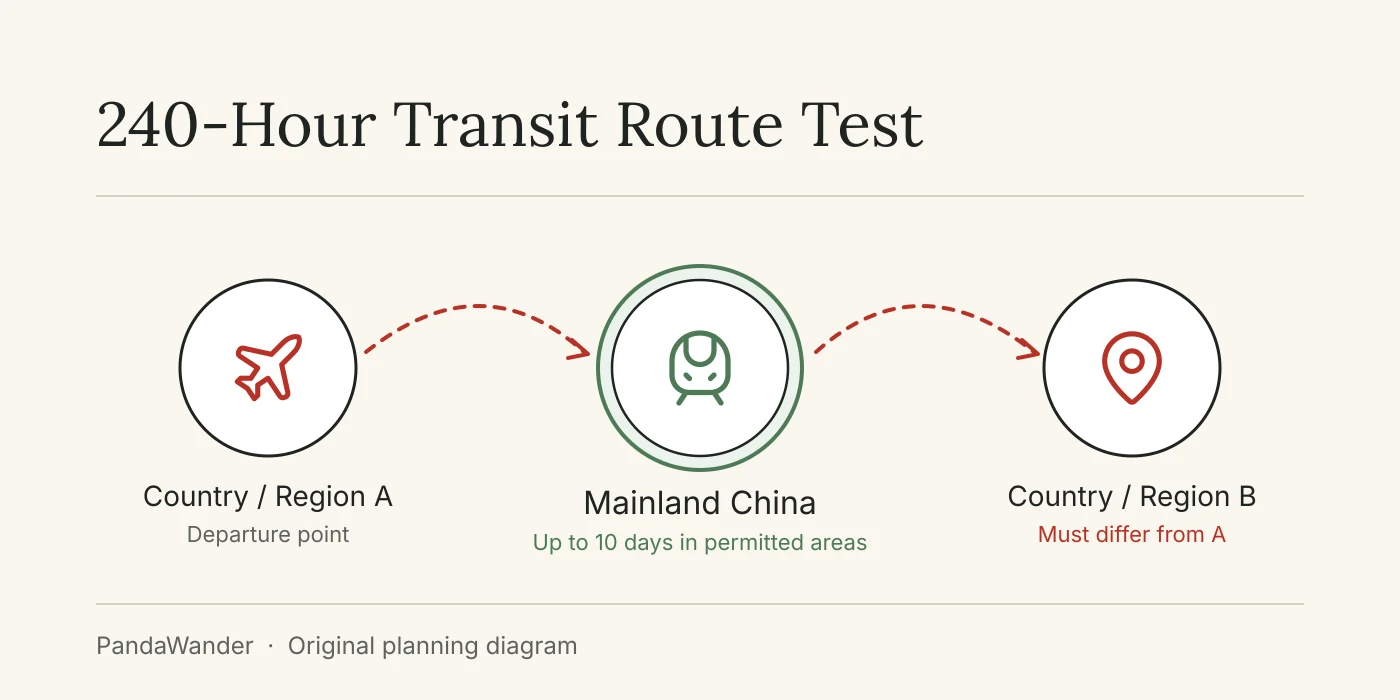
Does your flight route pass the Country A → China → Country B test?
Your ticket only fits the route rule if the country or region immediately before mainland China is different from the country or region immediately after mainland China. Use this rule: Country or Region A → mainland China → a different Country or Region B. Compare countries or regions, not cities.
Assuming nonstop flights on each leg, here is how the route test separates qualifying trips from round trips:
| Your flights | Does the route meet that rule? |
|---|---|
| Los Angeles, USA → Beijing, China → Tokyo, Japan | Yes, for the route requirement: USA before China, Japan afterwards. |
| Los Angeles, USA → Beijing, China → Los Angeles, USA | No: USA before and after China. |
| Los Angeles, USA → Beijing, China → New York, USA | No: a different US city still means returning to the same country. |
A “yes” here only clears the route geometry—it is not automatic admission. Two booking mistakes trip people up most often:
- Hidden connections or technical stopovers: A plane stopping somewhere and a separate connecting flight can be treated differently. Shanghai General Station of Immigration Inspection advises confirming with your airline whether an intermediate stop such as Hong Kong is a separate connecting flight rather than a direct-flight stopover, and notes that applicants need a valid international travel document with at least three months’ validity remaining and a confirmed onward ticket with a fixed date and seat.
- Returning via the same hub you arrived from: If you fly `San Francisco → Tokyo → Shanghai → Tokyo`, the immediate departure before China is Japan and the immediate exit after China is also Japan—that fails the third-country/region test even though your home is the United States. Change one side (for example exit Shanghai to Seoul, Taipei, Hong Kong or directly to the US) so the two sides differ.
Who is eligible and what do you need at check-in?
Holders of ordinary passports from the NIA’s listed countries qualify—including the United States, Canada, the United Kingdom, Australia, New Zealand, most European countries, Japan, South Korea, Singapore, Brazil and Mexico. China implements the 240-hour transit policy for nationals of 57 countries. That list also makes 240-hour transit a practical backup for UK, Canadian, Australian and European travelers planning a short 2027 visit while the 48-country 30-day waiver remains scheduled to end on 31 December 2026—see China 30-day visa waiver in 2027 for the latest status.
Check your exact passport on our 57-country and 65-port dataset (which includes the August 2026 additions of Kyrgyzstan and Vietnam), then put these four items in one accessible folder before airport check-in:
- Ordinary passport: Confirm you hold an ordinary passport (not an emergency or temporary travel document) with sufficient remaining validity—Shanghai immigration’s published guidance notes at least three months remaining, and individual airlines can check stricter rules.
- Confirmed onward ticket: Carry printed and offline confirmation showing a fixed departure date and confirmed seat to a third country or region within the stay limit. Standby, unconfirmed or open-dated tickets do not qualify.
- First accommodation details: Keep your first hotel name and address in Chinese and English offline for arrival paperwork and drivers.
- Arrival card: Submit the free official China arrival card online before flying, or complete it via QR code, kiosk or paper form upon landing.
Tell the airline check-in desk clearly that you are using China’s 240-hour transit policy so staff verify your onward booking against the transit rules rather than looking for an embassy visa sticker. Final admission is decided by border inspection.
Can you travel across provinces, and which ports and cities are open?
Yes—you can move across provinces during your stay, provided you enter and exit through designated ports and keep every overnight stop inside the permitted stay areas.
Eligible nationals may enter through any of the designated 65 open exit-entry ports under the 240-hour transit policy. The designated ports for the 240-hour transit policy are in 24 provinces, autonomous regions and municipalities directly under the Central Government. Eligible nationals under the 240-hour transit policy may stay in the permitted areas for no more than 10 days.
Under the NIA port-and-area table, eligible transit travelers may travel across the 24 participating province-level regions within their designated stay areas for no more than 240 hours, and must stay inside the listed cities where a province is not open in full.
That last caveat is critical when designing a multi-city route. Check both your ports and your sightseeing cities against the complete 65-port and permitted-area table before paying for hotels:
| Area scope | Examples from the official NIA port table |
|---|---|
| Entire municipality or province open | Beijing, Shanghai, Tianjin, Chongqing, Zhejiang (including Hangzhou and Yiwu), Jiangsu, Guangdong (exits available at all open ports across the province, including West Kowloon Station rail port and Hong Kong-Zhuhai-Macao Bridge port), Shaanxi (Xi’an), Hunan (including Changsha and Zhangjiajie), Hainan, Hubei, Fujian, Anhui, Shandong, Henan, Hebei, Liaoning and Guizhou |
| Listed cities only (partial-province scope) | Sichuan (11 listed cities including Chengdu and Leshan), Yunnan (9 listed cities/prefectures including Kunming, Dali, Lijiang and Xishuangbanna), Guangxi (12 listed cities including Guilin, Nanning and Beihai), Shanxi (Taiyuan and Datong only), Jiangxi (Nanchang and Jingdezhen only) and Heilongjiang (Harbin only) |
Because cross-province movement is allowed across permitted areas, popular two-hub combinations—such as landing in Shanghai (PVG/SHA), taking high-speed rail to Hangzhou and Beijing, and flying out of Beijing (PEK/PKX) to Tokyo or Seoul—fit the geographic framework as long as every stop stays inside permitted boundaries.
What activities are allowed—and when do you still need an L visa?
Tourism, business meetings, family visits and short exchanges are covered; paid work, study, journalism and simple round-trip vacations require a regular visa beforehand.
Foreign nationals covered by this policy may, within the designated areas, engage in activities like travel activities, business activities, visits, family reunions, etc., during their stay periods. Activities such as work, study, or news reporting still require prior approvals and appropriate visas.
Choose the regular tourist visa route instead of 240-hour transit if any of these apply:
- Your flights start and end in the same country or region (`US → China → US`) and adding a third-country stop costs more time or money than a visa.
- You want to stay longer than 10 days and your passport is not covered by an active 30-day waiver.
- Your itinerary includes destinations outside the designated stay areas.
The Chinese consulate's application guidance identifies the L visa as the category for tourism. For the consular application workflow, see China entry planning for US passport holders and our China entry overview.
How to turn a 240-hour transit stop into a smooth trip
Pick two hubs rather than four, and keep a buffer night in your departure city before your onward flight.
- Use a proven two-city route: Our Shanghai-in, Beijing-out 240-hour transit itinerary maps out a realistic 7-day pace with high-speed rail transfers and optional Hangzhou.
- Book intercity high-speed trains with your exact passport name: Follow how to book China trains with a foreign passport so you have confirmed seats between hubs without risking a missed international departure.
- Pick well-connected hotel bases near rail and airport links: Compare central neighborhoods in Shanghai, Beijing, Guangzhou, Shenzhen or Chengdu. For a late arrival or early onward flight, check Beijing Capital Airport hotels, Shanghai Pudong Airport hotels or Shenzhen airport overnight stays.
- Set up mobile data and payments before takeoff: Compare China data plans in Airalo vs Saily vs Yesim, complete the free China arrival card, and link a card in Alipay and WeChat Pay so you can scan and ride immediately after immigration.
Official policy links
- NIA: 240-Hour Visa-Free Transit Policy (English)
- NIA: 240-Hour Transit Policy Interpretation (Chinese)
- NIA Announcement No. 4 of 2026 (20 August 2026): Kyrgyzstan and Vietnam added
- Shanghai General Station of Immigration Inspection: Connections and stopovers FAQ
- Chinese Consulate-General in San Francisco: Tourist-visa (L) guidance
- Chinese Embassy in the US: Border inspection admission